


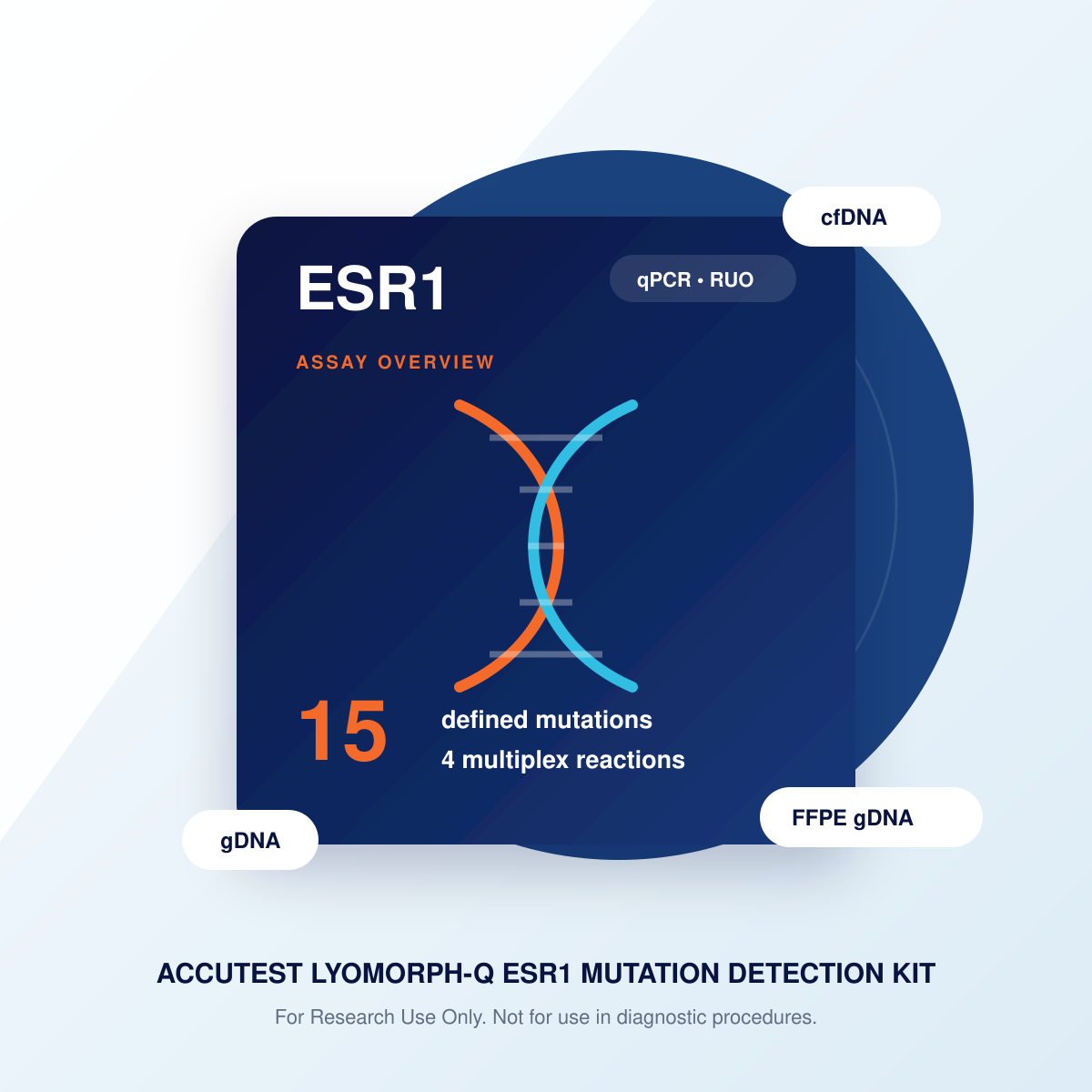
TARGETED ESR1 MUTATION RESEARCH
Accutest LyoMorph-Q
ESR1 Mutation Detection Kit
A focused, probe-based qPCR workflow for screening 15 defined ESR1 mutations associated with endocrine-therapy resistance research in breast cancer.
*Nominal capacity before controls, repeats or invalid reactions. Four reactions are required for a complete 15-mutation profile.
4 multiplex reactions
target dependent
target dependent
reported study conditions
verified instrument
One LyoMorph-Q platform. A growing oncology portfolio.
LyoMorph-Q uses standardized chemistry and cycling conditions across compatible targeted mutation panels, allowing multiple assays to run together on the same 96-well qPCR plate. The expanding portfolio supports focused solid- and blood-cancer research using cfDNA, FFPE-derived gDNA and gDNA.
Common workflow
Combine compatible mutation panels on one plate to improve throughput and reduce separate runs.
Growing assay menu
Build a scalable targeted-testing menu across established solid- and blood-cancer research panels.
Custom assay development
Discuss bespoke targets and panel combinations, including feasibility and low-minimum-order options.
Oncology technical support
Jant and SHARD can support instrument compatibility, assay selection, evaluation planning and technical review.
Accutest LyoMorph-Q oncology assays are powered by SHARD Diagnostics. All products are for Research Use Only and are not for use in diagnostic procedures.
Targeted sensitivity without adding a new testing platform
Designed for laboratories that already understand multiplex probe-based qPCR, the kit brings low-copy ESR1 mutation screening to familiar real-time PCR infrastructure. No separate preamplification or post-PCR mutation-detection step is required.
The four primer/probe mixes use standardized chemistry and cycling conditions, making the assay practical to integrate alongside other compatible mutation panels on the same 96-well plate.
Conserve limited samples
Supports inputs from 1 ng, with 5 ng or more recommended where available. Maximum input depends on sample type.
Use familiar qPCR workflows
Verified on the Agilent AriaDx. Other equivalent 96-well real-time PCR systems require local verification.
Reduce cold-chain burden
The complete kit can ship at ambient temperature. Component-specific storage requirements apply after receipt.
Run with defined controls
Includes a quantified positive control and RNase P on ATTO647N (Cy5) in Reaction 1 and HEX in Reaction 4.
Built for focused ESR1 screening
The assay detects mutation groups across codons 380, 422, 463 and 534–538. Because multiple mutations can share a fluorescence channel within one reaction, a positive signal may indicate a mutation group rather than a uniquely identified variant.
Target-specific low-copy detection
The reported 95% limit of detection was established using at least 19 clear positives in 20 replicates. Performance is target dependent and should be interpreted together with DNA input and absolute mutant-molecule availability.
0.01% VAF
0.016% VAF
0.06% VAF
Specificity in the reported study conditions
No false-positive mutation calls were reported at the tested wild-type inputs:
Results describe the reported study conditions and do not guarantee that false positives are impossible.
| Protein change / control | Sequence change | Mix | Fluorophore | 95% LoD |
|---|---|---|---|---|
| L536H | c.1607T>A | 1 | FAM | 3 copies • 0.01% |
| P535H | c.1604C>A | 1 | FAM | 3 copies • 0.01% |
| L536Q | c.1607_1608delinsAG | 1 | FAM | 3 copies • 0.01% |
| Y537D | c.1609T>G | 1 | FAM | 3 copies • 0.01% |
| V534E | c.1601T>A | 1 | FAM | 3 copies • 0.01% |
| E380Q | c.1138G>C | 1 | HEX | 3 copies • 0.01% |
| RNase P internal control | Human DNA control | 1 | ATTO647N (Cy5) | Not applicable |
| Y537S | c.1610A>C | 2 | FAM | 5 copies • 0.016% |
| Y537N | c.1609T>A | 2 | FAM | 5 copies • 0.016% |
| D538G | c.1613A>G | 2 | FAM | 5 copies • 0.016% |
| L536R | c.1607T>G | 2 | FAM | 5 copies • 0.016% |
| Y537C | c.1610A>G | 2 | FAM | 5 copies • 0.016% |
| V422del | c.1265_1267del | 3 | FAM | 3 copies • 0.01% |
| S463C | c.1388C>G | 3 | HEX | 3 copies • 0.01% |
| S463P | c.1387T>C | 3 | HEX | 20 copies • 0.06% |
| L536P | c.1607T>C | 4 | FAM | 5 copies • 0.016% |
| RNase P internal control | Human DNA control | 4 | HEX | Not applicable |
From extracted DNA to an interpretable run
Extract and quantify
Prepare cfDNA, FFPE-derived gDNA or gDNA and verify input concentration.
Reconstitute reagents
Rehydrate the lyophilized reagent mix with the specified buffer according to the current protocol.
Prepare four mixes
Set up each primer/probe mix as a separate reaction identity with controls and sample.
Run and interpret
Use the validated cycling and analysis settings. The verified PCR program is approximately 75 minutes.
ESR1 kit FAQs
Why investigate ESR1 mutations?
ESR1 mutations are studied in the context of acquired resistance to aromatase inhibitors and endocrine therapy. This kit is intended for molecular research and is not a tool for diagnosis or treatment selection.
Does the kit identify every mutation individually?
Not in every case. Several variants share a fluorescence channel within a reaction, so a positive result may identify a mutation group rather than one unique variant. The codon groups 380, 422, 463 and 534–538 can be distinguished.
How should the four assay mixes be organized?
Treat each primer/probe mix as a separate reaction identity and maintain a plate map linking the sample, assay mix, controls and fluorescence channels. A complete 15-variant profile requires all four mixes, although some research workflows may screen mixes containing higher-frequency variants first.
Can different mutation panels run on the same plate?
Compatible LyoMorph-Q mutation panels share standardized chemistry and cycling conditions, allowing multiple panels to run together on the same 96-well qPCR plate. Instrument optics, fluorescence channels and each assay’s specific requirements must still be verified.
What is the reported 95% limit of detection?
The reported 95% LoD is three mutant copies for eight variants, five copies for six variants and twenty copies for S463P. The protocol defines the 95% LoD criterion as at least 19 clear positive results in 20 replicates without indeterminate results.
How should 0.01% VAF be interpreted?
VAF is the proportion of mutant alleles relative to total target alleles, but detection also depends on the absolute number of mutant molecules in the reaction. In the reported study, three mutant copies at 0.01% VAF were demonstrated against approximately 30,000 wild-type target copies. By comparison, 30 ng of human DNA contains approximately 9,000 ESR1 allele copies, so 0.01% VAF represents an average of about 0.9 mutant copies per reaction. Under random molecular sampling, approximately 40% of reactions would contain no mutant molecules, making 95% detection mathematically impossible at that input and VAF.
What DNA inputs are supported?
The protocol specifies a minimum input of 1 ng and recommends at least 5 ng where available. Listed maximum inputs are 30 ng cfDNA, 25 ng FFPE-derived gDNA and 100 ng gDNA. Input beyond these limits may reduce specificity.
Is the assay quantitative?
The kit is designed primarily for sensitive mutation screening, not absolute mutant copy-number quantification. Ct values should not be interpreted directly as mutant molecule counts.
What does a missing RNase P signal mean?
A missing RNase P signal may indicate insufficient amplifiable human DNA, PCR inhibition, sample degradation, pipetting error or incorrect instrument settings. Review sample input, the assigned fluorescence channel, amplification curves and run controls before interpreting a mutation-negative result. Follow the current protocol’s internal-control acceptance criteria.
Which instrument is verified?
The assay has been verified on the Agilent AriaDx. Other equivalent 96-well qPCR systems require local verification of thermal performance, optical compatibility and analysis settings.
How is the kit shipped and stored?
The complete kit can ship at ambient temperature. The lyophilized reagent mixes are stable for up to 18 months at 15–25°C, with demonstrated stability for 30 days at 37°C. After receipt and reconstitution, follow the component-specific storage instructions in the current protocol.
Is this ESR1 workflow a fit for your laboratory?
Tell us your sample type, target requirements and qPCR instrument. Jant’s molecular team can help review compatibility, documentation and evaluation needs.