800.676.5565 | [email protected]



What is Minimal Residual Disease (MRD)?
A liquid Universal Solid Tumor Panel specifically designed for cell-free DNA (cfDNA) analysis. Enables ultra-sensitive detection of tumor-derived mutations in plasma for MRD monitoring, treatment response tracking, and early relapse detection across solid tumor types.
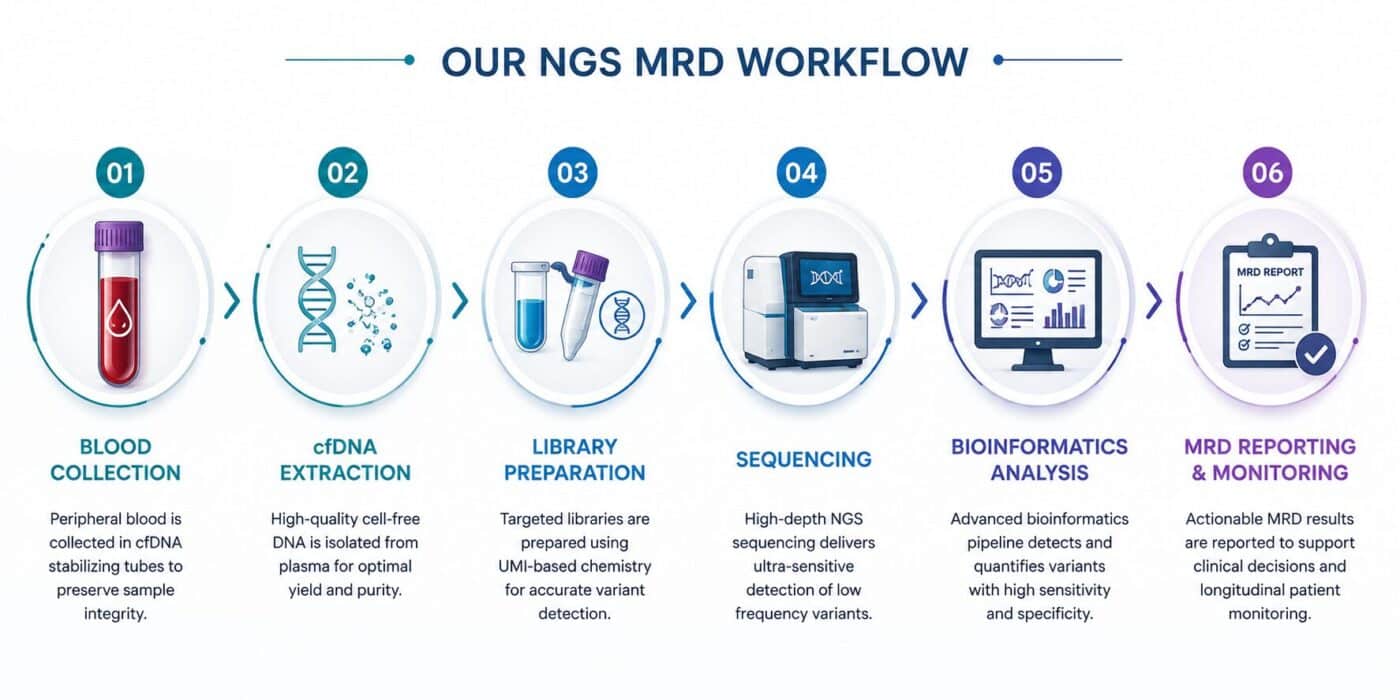
Why Hotspot + cfDNA + UMI?
Traditional PCR and standard NGS miss residual tumor cells at low variant allele frequencies. Jant’s MRD panel is a liquid Universal Solid Tumor Panel specifically engineered for cfDNA — the ideal matrix for non-invasive, serial MRD monitoring.
All 29 target genes are covered at established hotspot loci, optimizing sensitivity at positions most likely to harbor clinically relevant somatic mutations.
Unique Molecular Identifiers (UMIs) tag each individual DNA molecule before amplification, enabling bioinformatic error correction that distinguishes true low-frequency variants from PCR noise.
A tumor-informed RT-PCR MRD panel is currently in final validation, enabling personalized monitoring based on each patient’s specific mutation profile.
Universal Solid Tumor MRD Panel Coverage
Hotspot genes selected for clinically actionable biomarkers.
| SIGNAL TRANSDUCTION | RECEPTOR TYROSINE KINASES | TARGETED THERAPY / FUSION DRIVERS | ONCOLOGY & RESISTANCE MARKERS | ADDITIONAL TARGETS |
|---|---|---|---|---|
| EGFR | ALK | NTRK1 | TP53 | AKT1 |
| KRAS | MET | NTRK2 | PIK3CA | CDK6 |
| NRAS | RET | NTRK3 | ERBB2 | CTNNB1 |
| HRAS | ROS1 | FGFR1 | ERBB3 | IDH1 |
| BRAF | KIT | FGFR2 | ESR1 | IDH2 |
| MAP2K1 | PDGFRA | FGFR3 | AR |
29 clinically relevant hotspot genes optimized for cfDNA applications
Technical Specifications
MRD Panel at a Glance
<0.1%
VAF detection
threshold
threshold
10 ng
Minimum cfDNA
input
input
29
Hotspot genes
UMI
Error correction
6 hrs
Total prep time
2 hrs
Hands-on time
Illumina
Platform compatible
8–96
Samples per run
Clinical Applications of MRD Testing
Treatment Response Monitoring.
Quantitative monitoring of cfDNA levels during therapy enables assessment of molecular response earlier than radiographic imaging. Changes in MRD burden may correlate with therapeutic efficacy and tumor dynamics.
Early Detection of Molecular Relapse
MRD positivity can identify disease recurrence months before clinical or imaging evidence becomes apparent, allowing earlier intervention and improved patient management strategies.
Therapy Selection and Resistance Monitoring
Serial MRD analysis may identify the emergence of resistance-associated mutations such as EGFR, ESR1, KRAS, BRAF, MET, and ALK pathway alterations, supporting treatment adjustment decisions.
Prognostic Stratification
MRD status has emerged as an important prognostic biomarker associated with recurrence risk, progression-free survival, and overall survival across multiple tumor types.
Longitudinal Surveillance
Liquid biopsy MRD testing provides a minimally invasive approach for repeated monitoring throughout the patient journey, including post-surgical surveillance, adjuvant therapy assessment, and metastatic disease management.
Research Applications of MRD Testing
Biomarker Discovery and Validation
The panel supports translational oncology studies aimed at identifying molecular biomarkers associated with treatment response, recurrence risk, and resistance mechanisms.
Clinical Trial Applications
MRD endpoints are increasingly being incorporated into oncology clinical trials as surrogate markers for therapeutic efficacy and disease-free survival.
Minimal Residual Disease Kinetics
Serial cfDNA measurements provide insight into tumor burden dynamics and molecular response patterns over time.
Real-World Evidence and Outcomes Research
MRD testing supports generation of longitudinal molecular datasets for health economics studies, treatment optimization, and precision oncology initiatives.
Contracted Services
BEYOND THE KIT
In addition to supplying MRD NGS library preparation kits and reagents, Jant Pharmacal has partnered with select clinical reference laboratories to provide contracted MRD testing services.
●
PARTNER LAB NETWORK
Contracted partner labs serving leading academic and research institutions.
●
END-TO-END SUPPORT
From sample collection through variant reporting/secondary analysis.