


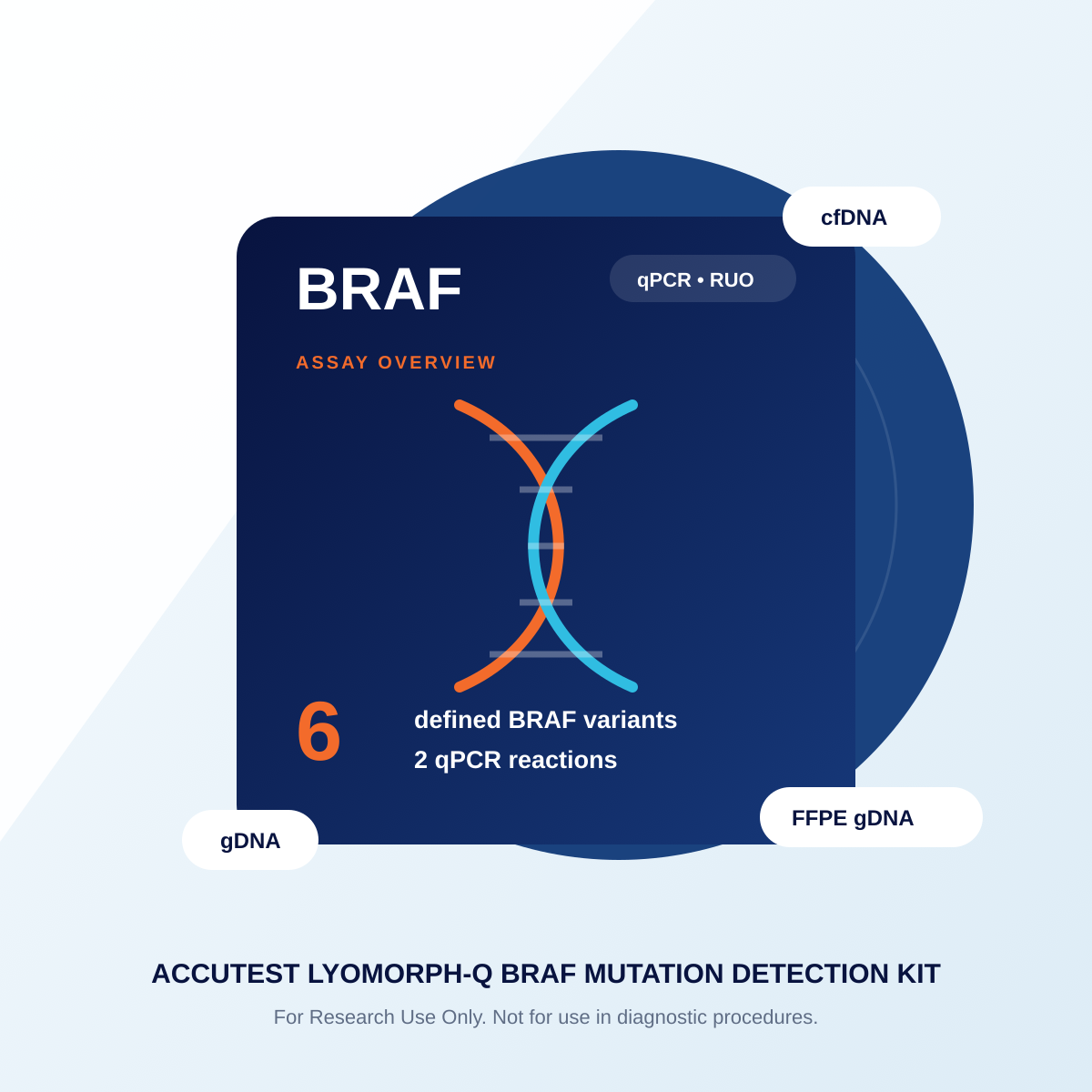
TARGETED BRAF MUTATION RESEARCH
Accutest LyoMorph-Q
BRAF Mutation Detection Kit
A highly sensitive, probe-based qPCR workflow for screening six defined BRAF variants across codons 600 and 601 in cfDNA, FFPE-derived gDNA and gDNA.
*The kit contains two primer/probe mixes. Each mix supports 96 reactions before controls, repeats or invalid reactions.
2 qPCR reactions
target dependent
target dependent
reported study conditions
on a 96-well cycler
One LyoMorph-Q platform. A growing oncology portfolio.
LyoMorph-Q uses standardized chemistry and cycling conditions across compatible targeted mutation panels, allowing multiple assays to run together on the same 96-well qPCR plate. The expanding portfolio supports focused solid- and blood-cancer research using cfDNA, FFPE-derived gDNA and gDNA.
Common workflow
Combine compatible mutation panels on one plate to improve throughput and reduce separate runs.
Growing assay menu
Build a scalable targeted-testing menu across established solid- and blood-cancer research panels.
Custom assay development
Discuss bespoke targets and panel combinations, including feasibility and low-minimum-order options.
Oncology technical support
Jant and SHARD can support instrument compatibility, assay selection, evaluation planning and technical review.
Accutest LyoMorph-Q oncology assays are powered by SHARD Diagnostics. All products are for Research Use Only and are not for use in diagnostic procedures.
Highly sensitive BRAF research in a familiar qPCR workflow
Designed for focused oncology research, the kit combines mutation-specific amplification with low-copy detection across six BRAF variants. No separate preamplification or post-PCR mutation-detection step is required.
Two primer/probe mixes use the universal LyoMorph-Q mastermix and shared cycling profile, supporting integration alongside compatible mutation panels on the same 96-well plate.
Detect low-copy variants
Reported 95% limits of detection are three or five mutant copies, depending on the target.
Cover key BRAF hotspots
Screen six defined variants across codons 600 and 601 using two probe-based qPCR reactions.
Reduce cold-chain burden
Lyophilized chemistry supports ambient shipping. Follow the current documentation for storage after receipt and reconstitution.
Run with defined controls
Each reaction includes an RNase P internal control in HEX, and the kit includes a dPCR-quantified positive control.
Built for focused BRAF research
Two mutation-specific reactions cover six defined BRAF variants. Reaction 1 detects V600E c.1799T>A, while Reaction 2 detects a second V600E sequence change together with K601E, V600D, V600K and V600R.
Target-specific low-copy BRAF detection
The reported 95% limit of detection was determined using 20 replicates on three instruments. Performance is target dependent and should be interpreted together with DNA input and absolute mutant-molecule availability.
0.0036% VAF
0.015% VAF
Specificity in the reported study conditions
No false-positive mutation calls were reported at the tested wild-type inputs:
Results describe the reported study conditions and do not guarantee that false positives are impossible in every sample or laboratory.
| Protein change / control | Sequence change | Reaction | Fluorophore | Reported 95% LoD |
|---|---|---|---|---|
| V600E | c.1799T>A | 1 | FAM | 3 copies • 0.0036% |
| RNase P internal control | Human DNA control | 1 | HEX | Not applicable |
| V600E | c.1799_1800TG>AA | 2 | FAM | 5 copies • 0.015% |
| K601E | c.1801A>G | 2 | FAM | 5 copies • 0.015% |
| V600D | c.1799_1800TG>AT | 2 | FAM | 5 copies • 0.015% |
| V600K | c.1798_1799GT>AA | 2 | FAM | 5 copies • 0.015% |
| V600R | c.1798_1799GT>AG | 2 | FAM | 5 copies • 0.015% |
| RNase P internal control | Human DNA control | 2 | HEX | Not applicable |
From extracted DNA to an interpretable run
Extract and quantify
Prepare cfDNA, FFPE-derived gDNA or gDNA and verify input concentration.
Reconstitute reagents
Rehydrate the lyophilized reagent mix with the specified buffer according to the current protocol.
Prepare two reactions
Set up each primer/probe mix as a separate reaction identity with the appropriate sample and controls.
Run and interpret
Use the validated cycling and analysis settings. The verified PCR program is approximately 75 minutes.
BRAF kit FAQs
Which BRAF variants are covered?
The kit screens six defined variants across codons 600 and 601: two sequence changes producing V600E, plus V600D, V600K, V600R and K601E.
Does the assay identify every variant individually?
Reaction 1 detects V600E c.1799T>A. Reaction 2 contains five BRAF targets in the FAM channel, so a positive signal in Reaction 2 indicates detection within that target group rather than uniquely identifying one of the five variants.
What are the reported limits of detection?
The reported 95% LoD is three mutant copies at 0.0036% VAF for V600E c.1799T>A and five mutant copies at 0.015% VAF for each of the five variants in Reaction 2.
How should low VAF results be interpreted?
VAF describes the proportion of mutant alleles relative to total target alleles, but successful detection also depends on how many mutant molecules are physically present in the reaction. Low-VAF results should therefore be interpreted together with DNA input, sample quality, amplification curves, internal-control performance and the current assay instructions.
What is the role of RNase P?
RNase P is an endogenous human-DNA internal control detected in HEX in both reactions. Its performance helps assess amplifiable sample input and identify potential inhibition, degradation, pipetting error or incorrect instrument settings.
Can compatible mutation panels run on the same plate?
Compatible LyoMorph-Q mutation panels use a universal mastermix and shared cycling profile, allowing multiple panels to run on the same 96-well qPCR plate. Instrument optics, fluorescence channels and each assay’s requirements must still be locally verified.
Which sample types are supported?
The assay is designed for cfDNA, FFPE-derived gDNA and gDNA. The performance study evaluated wild-type inputs of 30 ng cfDNA, 25 ng FFPE-derived gDNA and 100 ng gDNA.
Is the assay quantitative?
The kit is designed primarily for sensitive mutation screening, not absolute mutant copy-number quantification. Ct values should not be interpreted directly as mutant molecule counts.
How long is the PCR program?
The universal LyoMorph-Q cycling profile uses a 45-cycle, one-phase program completed in approximately 75 minutes on a standard 96-well qPCR cycler.
How is the kit shipped and stored?
The lyophilized kit supports ambient shipping. Follow the current product documentation for component-specific storage, reconstitution and stability requirements after receipt.
Is this BRAF workflow a fit for your laboratory?
Tell us your sample type, target requirements and qPCR instrument. Jant’s molecular team can help review compatibility, documentation and evaluation needs.