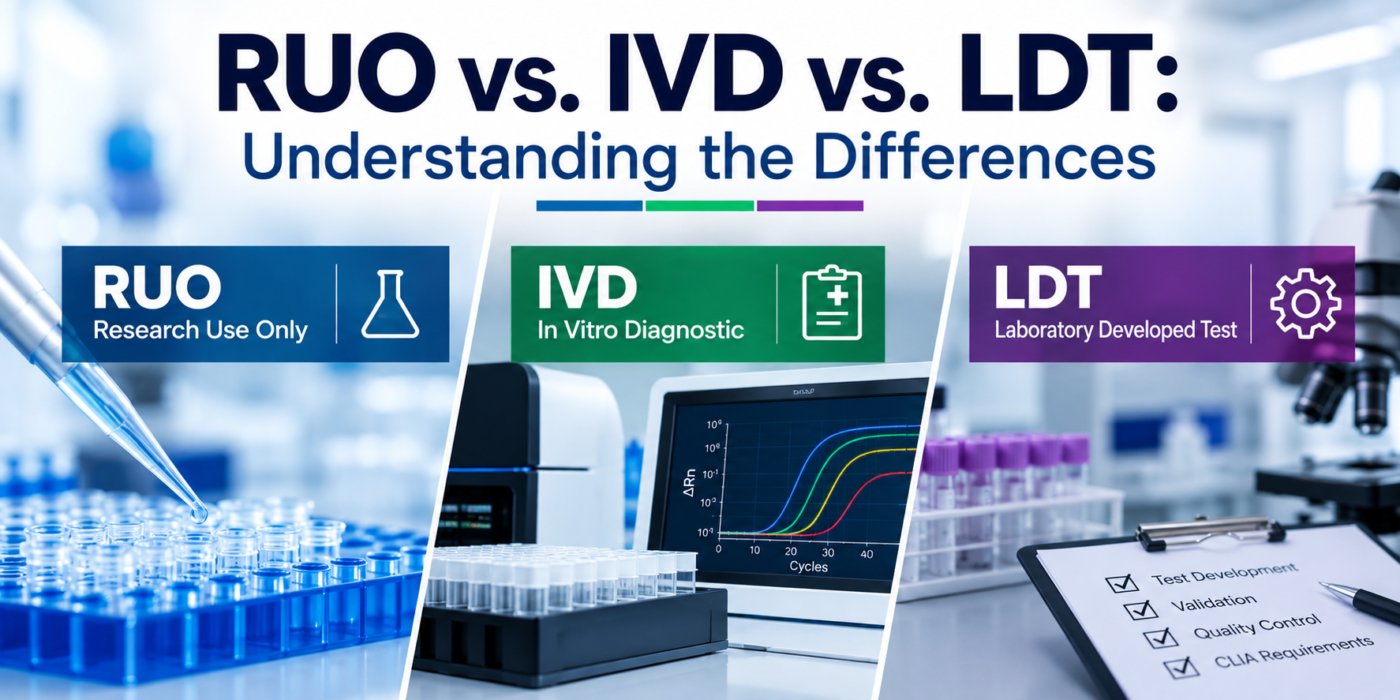
If you work with molecular reagents, panels or laboratory instruments, you are likely to encounter three terms frequently: RUO, IVD and LDT.
Although they are often discussed together, they describe different concepts. Understanding those differences is important when evaluating molecular products, reviewing intended use and planning laboratory workflows.
This guide explains what each term means, how they differ and some of the considerations laboratories should review when evaluating molecular testing products.
This article provides general educational information about commonly used laboratory regulatory terminology and is not legal, regulatory or compliance advice. Laboratories should consult applicable regulations and their regulatory, compliance or legal advisors regarding their specific circumstances.
What Does RUO Mean?
RUO stands for Research Use Only.
FDA regulations describe RUO IVD products as products in the laboratory research phase of development that are not represented as effective in vitro diagnostic products.
Under 21 CFR 809.10(c)(2)(i), these products must prominently carry the statement:
For Research Use Only. Not for use in diagnostic procedures.
RUO products may be used in research activities such as:
- Assay and method development
- Biomarker research
- Basic and translational research
- Feasibility studies
- Evaluation of potential molecular targets
An important point is that RUO is an intended-use and regulatory designation. It should not be interpreted by itself as a rating of a product’s analytical performance or manufacturing quality.
FDA also considers how a manufacturer represents and promotes a product—not simply the RUO statement printed on its label—when evaluating intended use.
What Does IVD Mean?
IVD stands for in vitro diagnostic.
In vitro diagnostic products include reagents, instruments and systems intended for use in the diagnosis of disease or other conditions, including determining a state of health, using specimens taken from the human body.
Examples can include tests performed on blood, tissue, urine, saliva, swabs and other human specimens.
Commercial IVD products are regulated as medical devices in the United States. Depending on the device classification and regulatory pathway, a product may be subject to FDA premarket review through mechanisms such as:
- 510(k) premarket notification
- De Novo classification
- Premarket approval (PMA)
The product’s labeling specifies its intended use, including the application and other conditions under which the product is intended to be used.
This creates one of the fundamental distinctions between RUO and IVD products:
An RUO product is labeled for research use and not for use in diagnostic procedures, while an IVD product is intended for a specified diagnostic use.
What Is an LDT?
LDT stands for laboratory developed test.
An LDT generally refers to an in vitro diagnostic test that is designed, manufactured and used within a laboratory rather than being commercially distributed as a finished diagnostic kit to multiple laboratories.
Laboratories may develop their own testing procedures for a variety of reasons, including situations in which their testing needs are not addressed by an existing commercially available test.
Clinical laboratory testing in the United States is subject to the Clinical Laboratory Improvement Amendments (CLIA), administered by the Centers for Medicare & Medicaid Services (CMS).
Under CLIA, laboratories using test systems that have not received FDA clearance or approval must establish applicable performance specifications before reporting patient test results, as described in 42 CFR §493.1253.
These requirements can include establishing or verifying characteristics relevant to the test system and its intended application.
RUO vs. IVD vs. LDT: What’s the Difference?
| Consideration | RUO | IVD | LDT |
|---|---|---|---|
| What the term describes | A product labeled for research use only | An in vitro diagnostic product | A test designed, manufactured and used within a laboratory |
| Stated intended use | Research use only; not for use in diagnostic procedures | Diagnostic use specified in product labeling | Clinical testing performed by the developing laboratory |
| Primary regulatory consideration | FDA requirements concerning RUO labeling, distribution and promotion | FDA medical-device requirements applicable to the specific product | Clinical laboratory requirements, including applicable CLIA requirements |
| Manufacturer’s stated use | Research only | Specified diagnostic application | Developed and performed within the laboratory |
The LDT Regulatory Landscape Has Changed
The regulatory landscape surrounding laboratory developed tests has changed substantially in recent years.
On May 6, 2024, FDA issued a final rule amending the definition of in vitro diagnostic products in 21 CFR 809.3(a) to explicitly state that IVDs are devices under the Federal Food, Drug, and Cosmetic Act, including when the manufacturer of the IVD is a laboratory.
That rule was subsequently challenged in federal court.
On March 31, 2025, the U.S. District Court for the Eastern District of Texas vacated and set aside the FDA’s final rule in American Clinical Laboratory Association v. U.S. Food and Drug Administration.
FDA subsequently issued a final rule on September 19, 2025 reverting the regulation to the wording that existed before the 2024 LDT final rule.
As a result, laboratories should be careful when relying on regulatory articles or guidance written during the period when FDA’s 2024 LDT framework was expected to take effect.
What Is the Enhancing CLIA Act of 2026?
The regulatory discussion surrounding LDTs is continuing in Congress.
On May 19, 2026, H.R. 8890, the Enhancing Clinical Laboratory Innovation and Access Act of 2026—also known as the Enhancing CLIA Act of 2026—was introduced in the U.S. House of Representatives.
The proposed legislation would amend the Public Health Service Act with respect to laboratory developed tests and establish an enhanced CLIA-based framework for their oversight.
Among other provisions, the proposed framework addresses areas including:
- Requirements related to test validity
- Information about laboratory developed tests
- Reporting of certain test errors
- The regulatory treatment of laboratory developed tests under CLIA and the Federal Food, Drug, and Cosmetic Act
As of September 2026, H.R. 8890 remains proposed legislation and has not become law. Laboratories should therefore monitor future legislative and regulatory developments rather than treating the proposal as a current requirement.
The RUO Distinction Remains Important
The changes surrounding LDT oversight do not eliminate the distinction between products labeled for Research Use Only and products intended for diagnostic use.
FDA’s RUO framework addresses how manufacturers label, distribute and promote products represented for research use.
Common Misconceptions About RUO, IVD and LDT
“RUO means lower quality.”
RUO is an intended-use and regulatory designation. It should not, by itself, be interpreted as a measure of a product’s analytical performance or manufacturing quality.
“RUO and IVD are just different labels.”
The distinction goes beyond the wording printed on a package. RUO and IVD products have different stated intended uses and are subject to different regulatory considerations.
“LDTs have no regulatory requirements.”
Clinical laboratories are subject to CLIA requirements, including requirements related to laboratory quality systems and test performance.
“The FDA’s 2024 LDT rule is currently being phased in.”
No. The 2024 final rule was vacated by a federal district court on March 31, 2025. FDA subsequently reverted the relevant regulation to its pre-2024 wording in September 2025.
Evaluating Molecular Products for Your Research Workflow?
Jant Pharmacal can help you review available molecular products, target coverage, sample requirements, extraction options and platform compatibility for your research application.
Research Use Only Molecular Solutions from Jant Pharmacal
Jant Pharmacal offers a growing portfolio of molecular research products, including:
- Real-Time PCR Solutions
- Standard Multiplex RT-PCR Panels
- Custom Pre-Plated RT-PCR Panels
- Next-Generation Sequencing (NGS) Solutions
- Nucleic Acid Extraction Solutions
Products referenced in this section are intended for research applications. Review each individual product page and its documentation for specific intended-use information and specifications.
Continue Exploring Molecular Testing
If you are evaluating molecular technologies for your laboratory, these Jant Pharmacal resources provide additional information:
- NGS vs. Real-Time PCR: Which Molecular Method Fits Your Lab?
- Respiratory Season 2026–27: Why Multiplex RT-PCR Matters for Labs
- Explore Molecular Testing Solutions
Looking for Molecular Research Products?
Tell us about your research workflow, target requirements and platform. Jant Pharmacal can help you review available RT-PCR panels, NGS solutions and nucleic acid extraction products.
This article provides general educational information and is not legal, regulatory or compliance advice. Molecular testing products referenced in this article are for Research Use Only (RUO) and are not for use in diagnostic procedures. Refer to individual product information for intended use.
Frequently Asked Questions
What does RUO mean?
RUO stands for Research Use Only. Under FDA regulations, qualifying products in the laboratory research phase must be prominently labeled “For Research Use Only. Not for use in diagnostic procedures.”
What is the difference between RUO and IVD?
RUO products are labeled for research use only and not for use in diagnostic procedures. IVD products are intended for specified diagnostic applications and are subject to applicable FDA medical-device requirements.
What is the difference between an IVD and an LDT?
IVD describes an in vitro diagnostic product. An LDT generally refers to a test designed, manufactured and used within a laboratory. The regulatory frameworks and responsibilities associated with commercially distributed IVD products and laboratory developed tests differ.
Are LDTs currently regulated under FDA’s 2024 final rule?
No. A federal district court vacated FDA’s 2024 LDT final rule on March 31, 2025. FDA subsequently reverted the relevant regulation to its pre-2024 wording in September 2025.
What is the Enhancing CLIA Act of 2026?
The Enhancing Clinical Laboratory Innovation and Access Act of 2026, H.R. 8890, is proposed federal legislation addressing laboratory developed tests under CLIA. It was introduced in the U.S. House of Representatives on May 19, 2026. As of September 2026, it has not become law.
Does RUO mean a product is lower quality?
No conclusion about product quality should be made from the RUO designation alone. RUO identifies the product’s intended research use and regulatory status; it is not, by itself, an analytical-performance or manufacturing-quality rating.
Are Jant Pharmacal molecular products IVDs?
The Jant Pharmacal molecular products referenced in this article are for Research Use Only and are not for use in diagnostic procedures. Review each individual product’s labeling and documentation for its specific intended use.
References
- U.S. Food and Drug Administration.
Distribution of In Vitro Diagnostic Products Labeled for Research Use Only or Investigational Use Only: Guidance for Industry and FDA Staff.
November 2013. - U.S. Food and Drug Administration.
In Vitro Diagnostic Device Labeling Requirements.
See 21 CFR 809.10. - Centers for Medicare & Medicaid Services.
Clinical Laboratory Improvement Amendments (CLIA).
See 42 CFR Part 493, including §493.1253. - American Clinical Laboratory Association v. U.S. Food and Drug Administration,
No. 4:24-CV-479-SDJ (E.D. Tex. Mar. 31, 2025). - U.S. Food and Drug Administration.
Laboratory Developed Tests.
Updated following the March 31, 2025 federal court decision and September 19, 2025 final rule. - U.S. Congress.
Enhancing Clinical Laboratory Innovation and Access Act of 2026.
H.R. 8890, 119th Congress, introduced May 19, 2026.