
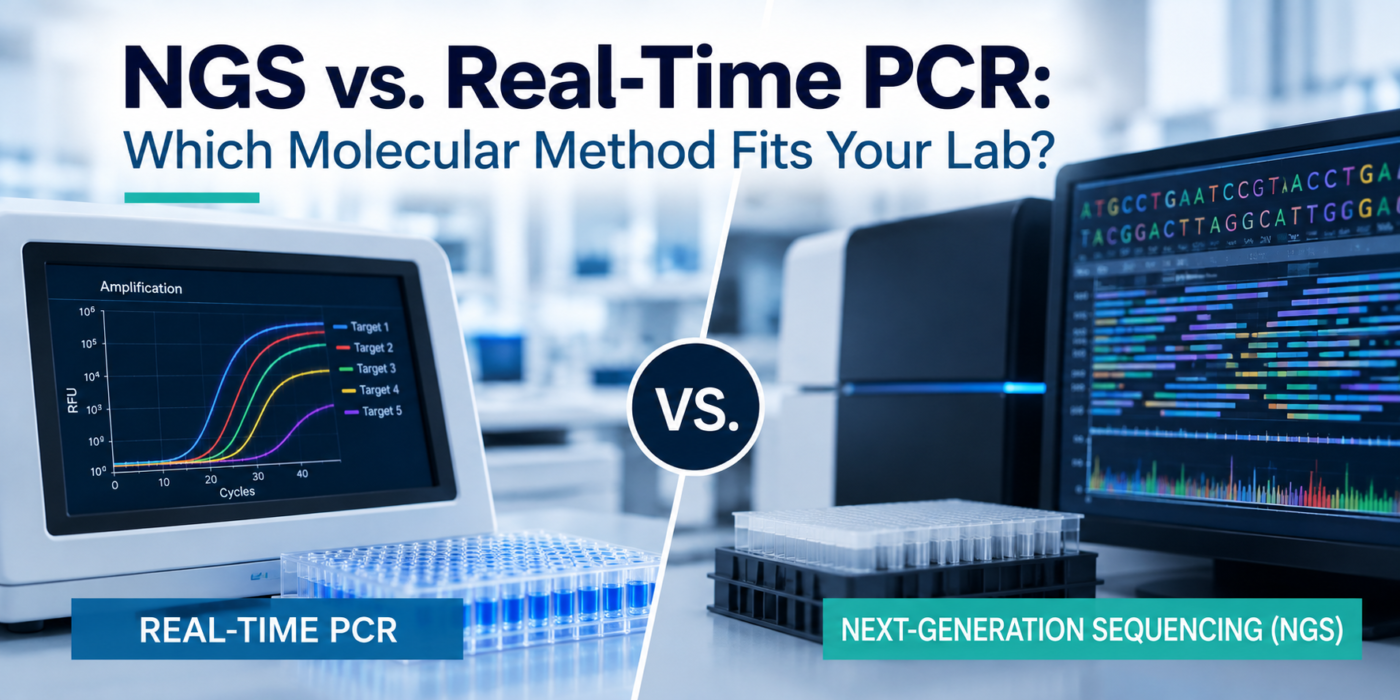
Real-time PCR and next-generation sequencing (NGS) are two widely used technologies in molecular laboratories, but they are not interchangeable. They answer different questions and place different demands on the laboratory workflow.
Choosing between them depends on what your lab needs to investigate, how many targets are involved, sample volume, turnaround requirements, available instrumentation and the data-analysis capabilities already in place.
For some laboratories, real-time PCR is the most practical approach. For others, the broader profiling capabilities of NGS are necessary. And increasingly, the two technologies are used together.
Here is how they compare—and what to consider when planning a molecular workflow.
What Real-Time PCR Does Well
Real-time PCR (qPCR) amplifies and detects specific, predefined nucleic acid targets while monitoring amplification through fluorescence as the reaction progresses.
It is fundamentally a targeted method: the laboratory determines in advance which sequences or variants the assay is designed to detect.
Real-time PCR can be particularly useful when:
- The targets are known and limited in number. Examples include a defined group of pathogens, genes or specific variants.
- Fast turnaround is important. Many real-time PCR workflows can be completed within hours, depending on the assay and upstream processing.
- A streamlined workflow is preferred. Real-time PCR generally requires less downstream data analysis than sequencing.
- Quantification is required. Depending on the assay design, qPCR can be used for applications involving relative or absolute nucleic acid quantification.
- Sample volumes are high. Targeted PCR workflows can be well suited to repeated analysis of known targets across larger numbers of samples.
Multiplex real-time PCR extends this approach by allowing several targets to be detected within the same reaction. The practical number of targets depends on factors including assay design and the fluorescence channels available on the instrument.
Respiratory pathogen research is one example. A focused multiplex assay can investigate SARS-CoV-2, influenza and RSV, while broader respiratory panels can incorporate additional viral and bacterial targets.
Read: Respiratory Season 2026–27: Why Multiplex RT-PCR Matters for Labs →
What NGS Does Differently
Next-generation sequencing approaches the question from another direction.
Rather than interrogating a small number of predefined targets, NGS can analyze many genes or genomic regions in parallel. Targeted NGS panels focus sequencing on a selected set of genes or regions, allowing laboratories to investigate substantially more genetic information within a single workflow.
This makes targeted NGS particularly useful when:
- Many genes or genomic regions need to be examined at once.
- Multiple variant types are relevant. Depending on panel design and analysis, these may include SNVs, indels, copy number changes and gene fusions.
- Broader variant detection is required. NGS can identify sequence changes within the targeted regions without requiring every individual variant to be predefined.
- Sample material is limited. A broader panel may allow multiple research questions to be investigated from the available nucleic acid.
- The research involves oncology, hereditary conditions or other applications where many biomarkers may be relevant.
A Practical NGS Example: Precision Oncology Research
Oncology research illustrates why broader molecular profiling can be useful.
The FFPE Precision Oncology NGS Panel offered by Jant Pharmacal covers 191 genes for DNA alterations, including SNVs, indels and CNVs, along with 143 genes for RNA fusion detection.
The integrated DNA and RNA workflow is designed for FFPE tissue and fine needle aspirate specimens.
Its partner-agnostic RNA approach is designed to detect known and novel fusion events without requiring both fusion partners or exact breakpoint locations to be predefined.
This illustrates one of the important distinctions between sequencing and highly targeted PCR: when broader characterization is required, NGS can interrogate substantially more genomic information within the same overall testing strategy.
Explore the FFPE Precision Oncology NGS Panel →
Expanding Your Molecular Testing Capabilities?
Whether your laboratory is evaluating real-time PCR, adding NGS to an existing molecular workflow, or considering both, Jant Pharmacal can help you review available panels, sample requirements and platform compatibility.
NGS vs. Real-Time PCR: Side-by-Side
| Consideration | Real-Time PCR | Targeted NGS |
|---|---|---|
| Primary approach | Targeted detection of predefined sequences | Broader sequencing of selected genes or genomic regions |
| Number of targets | Typically limited compared with NGS | Can cover dozens to hundreds of genes, depending on panel design |
| Variant detection | Primarily predefined targets or variants | Broader variant detection within targeted regions |
| Turnaround | Generally faster | Generally longer due to library preparation, sequencing and analysis |
| Data analysis | Generally less extensive | More extensive bioinformatics analysis |
| Workflow complexity | Generally lower | Generally higher |
| Cost considerations | Often economical for a limited number of targets | Economics depend on panel size, sample volume, batching and sequencing platform |
| Typical strength | Focused analysis of known targets and quantification | Broader molecular profiling and characterization |
The Trade-Offs to Plan For
NGS provides substantially more information, but that additional information comes with additional workflow requirements.
Laboratories considering sequencing should evaluate several areas before implementation.
Sequencing Capacity and Batching
NGS workflows may benefit from batching samples efficiently. Instrument access, run size and scheduling can therefore affect both workflow efficiency and turnaround time.
Bioinformatics
Generating sequencing data is only part of the process. NGS data must also be processed, analyzed and interpreted using appropriate software and expertise.
Bioinformatics capability should therefore be considered part of the NGS workflow—not an afterthought.
Sample Quality
Input nucleic acid quality can affect both PCR and sequencing, but it becomes particularly important in applications involving challenging material such as FFPE specimens or low-input samples.
Extraction method, nucleic acid yield, purity and quality control should be considered alongside panel selection.
Explore Nucleic Acid Extraction Solutions →
Verification and Validation
Any new molecular assay or workflow should be appropriately verified or validated for its intended application and used in accordance with applicable laboratory requirements and product instructions.
Many Molecular Laboratories Use Both Technologies
The decision does not always have to be NGS or real-time PCR.
The technologies can complement one another because they address different molecular questions.
Real-time PCR can provide a focused approach for known targets and high-throughput workflows, while NGS can provide broader molecular characterization when substantially more genomic information is required.
Depending on the research workflow, a laboratory might use PCR for initial targeted analysis and NGS for deeper characterization. In other applications, PCR may be used to investigate or confirm a specific finding identified through sequencing.
Both approaches also depend on a critical upstream step: nucleic acid extraction. Inconsistent yield, purity or sample quality can compromise downstream molecular workflows regardless of which technology is used.
Choosing a Method Based on the Research Question
Consider Real-Time PCR When:
- The targets of interest are already known.
- A relatively small number of targets needs to be investigated.
- Fast turnaround is an important workflow requirement.
- Large numbers of samples need to be processed against the same targets.
- Quantification is part of the research objective.
- The laboratory wants to minimize downstream data-analysis requirements.
Consider Targeted NGS When:
- Many genes or genomic regions need to be investigated simultaneously.
- Several types of genomic alterations are relevant.
- Broader variant or fusion characterization is required.
- Available sample material needs to support multiple research questions.
- The laboratory has access to the sequencing and bioinformatics resources required for the workflow.
Consider a Combined Workflow When:
- Routine targeted analysis is performed at scale, but selected samples require deeper characterization.
- The laboratory is expanding from PCR into sequencing and wants to add NGS capabilities while maintaining existing PCR workflows.
- Different research questions within the laboratory require different levels of molecular information.
NGS Solutions from Jant Pharmacal
Jant Pharmacal offers molecular laboratories both real-time PCR solutions and a growing portfolio of next-generation sequencing solutions.
Available NGS panels include:
FFPE Precision Oncology NGS Panel
Designed for FFPE and fine needle aspirate specimens, the panel combines DNA and RNA analysis with coverage of 191 genes for DNA alterations and 143 genes for RNA fusion detection.
Explore the FFPE Precision Oncology NGS Panel →
RNA Fusion NGS Panel
Designed for laboratories with an established DNA workflow that want to add RNA fusion analysis, the panel covers 143 genes and uses a partner-agnostic approach for detecting known and novel fusion events without requiring both fusion partners or exact breakpoint locations to be predefined.
Explore the RNA Fusion NGS Panel →
MRD Liquid Biopsy NGS Panel
This 29-gene hotspot panel is optimized for cell-free DNA (cfDNA) research applications and incorporates unique molecular identifiers (UMIs) for error correction. The panel is designed for sensitive variant detection in liquid biopsy research workflows.
Explore the MRD Liquid Biopsy NGS Panel →
Hereditary Hot Spot NGS Panel
The Hereditary Hot Spot NGS Panel targets approximately 537 genes across seven hereditary disease categories and includes copy number variant analysis across a subset of genes.
Explore the Hereditary Hot Spot NGS Panel →
Explore All Jant Pharmacal NGS Solutions →
Planning Your Next Molecular Workflow?
Whether you are expanding an existing real-time PCR workflow, evaluating targeted NGS or considering how the two technologies can work together, Jant Pharmacal can help you review panel options, sample requirements and platform compatibility.
Molecular testing products referenced in this article are for Research Use Only (RUO) and are not validated for diagnostic procedures. Refer to individual product information for intended use.
Frequently Asked Questions
Is NGS better than real-time PCR?
Neither technology is universally better. Real-time PCR and NGS answer different molecular questions. Real-time PCR is well suited to focused analysis of predefined targets, while targeted NGS can investigate substantially more genomic information in parallel. The appropriate method depends on the research objective and laboratory workflow.
Can NGS replace real-time PCR?
Not necessarily. The technologies can be complementary. A laboratory may use real-time PCR for focused, high-throughput analysis of known targets while using NGS when broader genomic characterization is required.
Can real-time PCR detect genetic variants?
Yes. Real-time PCR assays can be designed to detect specific genetic variants. However, the variant generally needs to be predefined in the assay design. Targeted NGS can provide broader sequence information across the genomic regions included in the panel.
What sample types can be used with NGS panels?
Sample requirements depend on the individual panel. For example, Jant Pharmacal’s FFPE Precision Oncology NGS Panel is designed for FFPE tissue and fine needle aspirate specimens, while the MRD Liquid Biopsy NGS Panel is designed for cfDNA research applications. Review the specifications of each panel for sample requirements.
What does a laboratory need to begin running NGS?
Requirements depend on the selected panel and workflow but may include a compatible sequencing platform, appropriate nucleic acid extraction and quality-control procedures, library preparation reagents and bioinformatics capabilities for processing and analyzing sequencing data.
Does NGS require bioinformatics?
Yes. Sequencing generates data that must be processed and analyzed. The required bioinformatics resources depend on the panel, sequencing platform, analysis software and research application.
Are Jant Pharmacal NGS panels for diagnostic use?
No. The Jant Pharmacal NGS panels referenced in this article are for Research Use Only (RUO) and are not validated for diagnostic procedures. Review each product’s intended use before use.
References
- Cappello F, Angerilli V, Munari G, et al. FFPE-Based NGS Approaches into Clinical Practice: The Limits of Glory from a Pathologist Viewpoint. Journal of Personalized Medicine. 2022;12(5):750. doi:10.3390/jpm12050750.
- Jant Pharmacal Corporation. FFPE Precision Oncology NGS Panel.
- Jant Pharmacal Corporation. RNA Fusion NGS Panel.
- Jant Pharmacal Corporation. MRD Liquid Biopsy NGS Panel.
- Jant Pharmacal Corporation. Hereditary Hot Spot NGS Panel.